Ho Chi Minh City’s economy continued to expand during the first eight months of 2026 despite global uncertainty stemming from geopolitical conflicts, rising trade protectionism, energy prices and logistics costs. Industrial production, domestic consumption, and import-export activities all recorded growth, while the city continued to pursue its goal of achieving double-digit economic growth.
According to Ho Chi Minh City’s industry and trade authorities, industrial production remained one of the city’s key economic drivers, while domestic trade and international trade also continued to expand.
Ho Chi Minh City’s Industrial Output Grows Nearly 11% in Eight Months
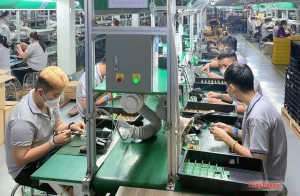
Bui Ta Hoang Vu, Director of the Ho Chi Minh City Department of Industry and Trade, said the city’s manufacturing sector maintained strong growth momentum during the first eight months of 2026.
The Industrial Production Index (IIP) increased by 10.6% year on year in August 2026. For the first eight months of the year, IIP was estimated to have risen by approximately 10.8%, significantly higher than the 5.5% growth recorded during the same period in 2025.
Several industries recorded double-digit growth, including food processing at 12.2%, paper manufacturing at 12.3%, coke and refined petroleum products at 107.4%, chemicals at 19.7%, fabricated metal products at 20.3%, and other transport equipment at 17.3%.
Among Ho Chi Minh City’s four key industries, IIP increased by 11.7% during the first eight months. Food processing grew 11.4%, pharmaceuticals increased 15.5%, and mechanical engineering rose 14.5%.
These figures highlight the continued importance of manufacturing to the Ho Chi Minh City economy and its role in supporting the city’s industrial growth targets for 2026.
Domestic Consumption Supports Ho Chi Minh City Economy
In addition to industrial production, domestic consumption remained another important driver of economic activity.
Total retail sales of goods and consumer services in Ho Chi Minh City reached approximately VND 174.73 trillion in August, up 16.5% from the same month of 2025. During the first eight months of the year, total retail sales reached around VND 1,308.51 trillion, representing growth of 13.7%.
Retail sales of goods alone amounted to approximately VND 617.41 trillion, up 17.2%, reflecting stronger domestic purchasing activity amid improving macroeconomic conditions.
Ho Chi Minh City currently has 66 shopping malls, 300 supermarkets, 405 traditional markets and approximately 3,653 convenience stores, providing an extensive retail network to meet consumer demand.
Meanwhile, e-commerce continues to play an increasingly important role. Platforms such as Shopee, Lazada and TikTok Shop have helped businesses expand their customer base and sales channels, particularly during periods of intensified promotional campaigns and consumer stimulus.
Ho Chi Minh City Exports Rise 7.82%
Import and export activity in Ho Chi Minh City continued to expand during the first eight months of 2026.
The city’s exports were valued at approximately US$8.45 billion in August, up 7.34% year on year. During the first eight months, cumulative exports reached around US$65.83 billion, an increase of 7.82%, compared with 6.1% growth during the same period in 2025.
Export growth was supported by a gradual recovery in demand from major markets, as well as businesses making greater use of incentives and commitments under various free trade agreements (FTAs).

Imports reached approximately US$9.46 billion in August, up 16.68%. For the first eight months, cumulative imports totaled around US$72.69 billion, increasing 7.9% year on year.
Imports were largely made up of raw materials, electronic components, machinery and equipment used for production and export manufacturing, reflecting continued expansion in industrial activity.
Ho Chi Minh City Restructures Production to Adapt to Global Economy
Despite continued trade growth, businesses still face uncertainty from the global economy, particularly tensions in the Middle East that have affected logistics costs, transportation times and the costs of certain products, including food, seafood, textiles and electronics.
Tran Phu Lu, Deputy Director of the Investment and Trade Promotion Center of Ho Chi Minh City (ITPC), said that to support the city’s targets for export growth and double-digit GRDP growth, Ho Chi Minh City needs to accelerate the restructuring of its industrial and agricultural sectors toward more modern, environmentally friendly and circular production models.
These efforts will be linked to digital transformation, the green transition and greater participation by businesses in regional and global value chains.
Logistics Infrastructure Investment to Reduce Trade Costs
Another key strategy for Ho Chi Minh City is developing infrastructure to support trade and investment, particularly logistics infrastructure aimed at reducing costs and improving the efficiency of import and export operations.
The city is prioritizing the development of an international financial center, a free trade zone, smart logistics centers, an international transshipment port cluster and air cargo infrastructure.
At the same time, Ho Chi Minh City is working to improve its business environment and encourage companies to comply with international standards, particularly environmental, digital transformation and sustainability standards that are increasingly important for exports to major markets such as the United States and European Union.
Ho Chi Minh City Steps Up Measures to Achieve Double-Digit Growth
For September and the remainder of 2026, Ho Chi Minh City’s industry and trade authorities will focus on measures aligned with the city’s target of achieving double-digit economic growth.
One of the key priorities is the development of a plan for a National Energy Industry Center, covering natural gas, liquefied natural gas (LNG), electricity, refining, petrochemicals and renewable energy.
The city is also advancing its Ho Chi Minh City Industrial Development Strategy to 2030, with a Vision to 2050, including measures to increase domestic production and localization in basic, core and strategically important industries.
The Ministry of Industry and Trade is also preparing a list of key and high-potential industrial products for 2026-2030, along with measures to support domestic production and electricity consumption, stimulate demand and promote trade.
Toward the end of the year, Ho Chi Minh City is also expected to organize a series of industrial and trade promotion activities, including an exhibition of rural industrial products from southern Vietnam and the selection of the “Ho Chi Minh City Golden Brand 2026.”
Overall, the performance of the Ho Chi Minh City economy in 2026 points to a broader shift away from growth driven primarily by manufacturing and trade toward higher-value growth supported by technology, digital transformation, logistics, green production and deeper integration into global supply chains.
Source :
www.congthuong.vn
www.thanhtra.com.vn
Viet Star Shipping Agency Co., Ltd.
📞 +84 3930 01002
🏘️27-29 Ngo Thi Bi Street, Tan Hung Ward, Hochiminh City