Iran has signaled a possible reopening of the Strait of Hormuz after announcing that a new shipping route agreement with Oman is nearing completion. However, Tehran says the strategic waterway will not fully reopen until the United States addresses key demands, keeping global energy markets on alert.
Iran and Oman Near Agreement on New Shipping Route
On August 9, Iranian Foreign Minister Abbas Araghchi said Iran and Oman were close to finalizing an agreement on a new shipping route through the Strait of Hormuz.
The agreement could help address shipping and navigation challenges in the strategic waterway. However, Araghchi stressed that it would not be enough to restore normal maritime traffic through the Strait, as tensions between Iran and the United States remain unresolved.
Communication between Tehran and Washington is currently being conducted through intermediaries. Iran has maintained that the Strait of Hormuz will not fully reopen until the United States changes its position toward Tehran.
Iran Sets Conditions for Full Reopening of the Strait of Hormuz
According to Araghchi, Washington must address several issues that Iran considers essential to easing the current tensions, including U.S. sanctions, military operations, frozen Iranian assets and compensation for damages that Tehran says resulted from previous attacks.
Earlier, Iran’s Tasnim news agency reported that the Supreme National Security Council had outlined conditions for reopening the Strait of Hormuz. These reportedly include:
- Ending the war on all fronts
- Lifting blockades on Iranian ports
- Removing U.S. sanctions
- Releasing frozen Iranian assets
- Providing compensation for war-related damages
The conditions have turned the Strait of Hormuz into a major bargaining point between Iran and the United States, while global markets closely monitor diplomatic developments and the possibility of a full reopening.
Strait of Hormuz: A Critical Energy Route
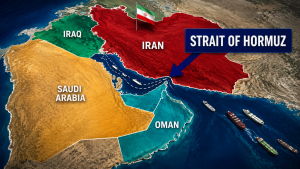
The Strait of Hormuz, located between Iran and Oman, connects the Persian Gulf with the Gulf of Oman and the Arabian Sea. It is one of the world’s most important routes for global oil and gas transportation.
Data from the U.S. Energy Information Administration (EIA) shows that an average of 20.9 million barrels per day of crude oil and petroleum products passed through the Strait during the first half of 2025.
That volume represented approximately 20% of global oil consumption and around one-quarter of all oil transported by sea worldwide.
The Strait is also a major route for liquefied natural gas (LNG). Approximately 20% of global LNG trade passed through the waterway in 2024, with major shipments originating from Qatar and the United Arab Emirates. Around 83% of these LNG cargoes were destined for Asian markets, including China, India and South Korea.
Limited Alternatives Raise Global Oil Price Risks
Alternative routes for transporting oil remain limited. Saudi Arabia and the United Arab Emirates have pipelines with a combined capacity of approximately 4.7 million barrels per day, which limits their ability to fully compensate for prolonged disruptions through the Strait of Hormuz.
A sustained disruption could therefore reduce global oil supplies and place upward pressure on crude oil prices, LNG prices and transportation costs.
The impact has already been reflected in energy markets. According to EIA data, disruptions to LNG flows through the Strait since late February have prevented more than 283 million cubic meters of LNG per day from passing through the waterway, equivalent to roughly 20% of global LNG volumes.
Natural gas prices in Europe and East Asia have also risen significantly amid concerns over supply disruptions.
Oil Markets Watch Iran-U.S. Tensions
Global energy markets are now watching two developments closely: the progress of the Iran-Oman shipping agreement and the possibility of diplomatic progress between Iran and the United States.
A successful agreement between Tehran and Washington could pave the way for the full reopening of the Strait of Hormuz, easing pressure on global oil and LNG markets and reducing risks to international supply chains.
However, if negotiations remain stalled, the Strait of Hormuz is likely to remain a major risk factor for global energy markets, with potential consequences for oil prices, LNG supplies, shipping costs and the wider global economy.
source :
www.reuters.com
www.vietnam.vn
Viet Star Shipping Agency Co., Ltd.
📞 +84 3930 01002
🏘️27-29 Ngo Thi Bi Street, Tan Hung Ward, Hochiminh City