Global container freight rates continued to diverge in November 2026. The WCI fell 3%, while the Intra – Asia index (IACI) rose to US$1,444 per 40ft. The Asia – Europe route showed signs of recovery, driven by demand and the Peak Season Surcharge (PSS).
Global Container Shipping Market Continues to Diverge Across Trade Lanes
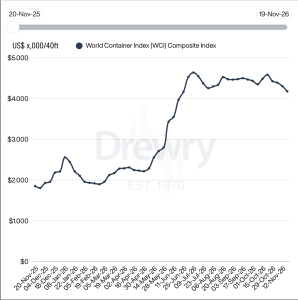
The global container shipping market is recording opposing trends across key trade lanes. While freight rates on the Trans – Pacific route continue to decline on weakening shipping demand, the Asia-Europe route is beginning to show signs of recovery. For the Intra – Asia market, rates have remained generally stable, although pressure varies considerably across regional transport corridors.
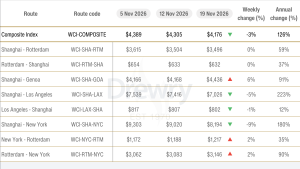
According to the Drewry World Container Index (WCI) published on November 19, 2026, the global container freight index fell 3% to US$4,176 per 40-foot container. This was the fourth consecutive weekly decline for the WCI, driven mainly by the downward trend in Trans-Pacific rates. Even so, the index remains 126% higher year over year, reflecting a container freight rate level that is still substantially elevated.
Meanwhile, the Drewry Intra-Asia Container Index (IACI) posted a slight increase of US$4, reaching US$1,444 per 40-foot container. Intra-Asia rate levels were broadly stable, as easing pressure on the North East Asia corridors offset mounting strain on Southeast Asia trade lanes.
These developments show that the container shipping market is not moving in a single unified direction. Differences in cargo demand, port congestion, handling capacity, and carriers’ pricing strategies are generating distinct movements in each region. Market assessment therefore needs to be carried out simultaneously across major trade lanes rather than relying on a single headline index.
For import-export businesses, shippers, and freight forwarders, this divergence demands close monitoring of freight rates, vessel schedules, and surcharge adjustment notices. Timely updates on each route will help businesses stay ahead in transportation planning and logistics cost control.
Trans – Pacific Rates Fall for the Seventh Consecutive Week
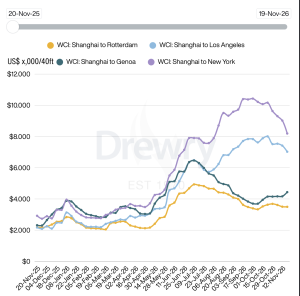
On the Trans – Pacific route, spot rates continued their downward trend for the seventh straight week. This has been one of the main factors dragging the WCI lower recently, as shipping demand on the Asia – North America route is no longer holding at the positive levels seen earlier.
According to Drewry data, the rate for shipping a container from Shanghai to New York fell 9% to US$8,194 per 40-foot container – the lowest level in 15 weeks. Meanwhile, the Shanghai – Los Angeles route fell 5% to US$7,026 per 40-foot container, a 12-week low. Both routes recorded declining trends, reflecting the ongoing rate correction pressure in the Trans-Pacific shipping market.
The main cause is weakening transport demand, forcing carriers to adjust their operations to curb overcapacity. When cargo volumes cannot absorb the slot capacity offered, price competition among carriers may intensify. This keeps spot rates under downward pressure, particularly on highly competitive routes.

In response, carriers are proactively deploying blank sailings to control supply and balance operating capacity. According to Drewry Container Capacity Insight, 10 blank sailings have been announced for the following week, up from 4 in the current week. However, the capacity cuts have not yet been enough to reverse the market trend. Drewry forecasts that Trans – Pacific rates may fall further next week.
Additionally, Freight Right has warned that shippers should not expect steep rate declines in the short term. Through late November and early December, ocean freight rates are likely to remain relatively stable at certain points. The reason is that carriers are maintaining weekly sailing schedules while holding back from deploying additional vessels, to avoid worsening the overcapacity situation.
Several carriers have also begun announcing rate increases and surcharges for the coming period. However, these adjustments should be viewed in the context of still-weak actual transport demand. Rate hikes may shift the rate floor to some extent, but whether the new levels hold will depend significantly on supply – demand dynamics in the market.
Asia – Europe Route Recovers on Transport Demand and Peak Season Surcharge
In contrast to the Trans-Pacific downturn, the Asia – Europe shipping market is showing more positive signals. After a period of stable rates, several routes have posted renewed gains, while carriers have begun rolling out Peak Season Surcharge (PSS) plans to capture rising shipping demand in December.
Specifically, the rate from Shanghai to Genoa rose 6% to US$4,436 per 40-foot container after three consecutive weeks of stability. Meanwhile, the Shanghai – Rotterdam route held steady at US$3,496 per 40-foot container. The divergence between the two routes shows that the recovery is not yet uniform, even though the Asia – Europe market is benefiting from more supportive factors than the Trans – Pacific.
One key factor supporting the rate outlook is the expectation that shipping demand will improve in December, ahead of the new contract negotiation season and preparations for Lunar New Year. As transport demand trends upward, carriers gain more grounds to adjust rates and introduce surcharges to strengthen operating revenue.
Accordingly, many carriers have announced Peak Season Surcharges (PSS) on Asia -Europe and Mediterranean routes. The announced surcharge levels range from US$1,000 to US$1,600 per 40-foot container, expected to take effect from December 1. This is one of the notable moves by carriers as they attempt to lift the rate floor ahead of an anticipated upturn in demand.
On the capacity side, Drewry recorded 4 blank sailings on the Asia – Europe route in the following week, down from 5 in the current week. This shows carriers are still using capacity management to balance supply, but the scale of sailings cuts on this route is milder than on the Trans-Pacific.
Drewry forecasts that Asia – Europe rates have the potential to rise in the coming weeks. This outlook is supported by expected improvement in December demand, together with carriers beginning to apply the PSS. However, the actual pace of recovery will depend on the market’s capacity absorption and cargo demand trends in the period ahead.
Intra – Asia Rates Stay Stable as IACI Rises to US$1,444/40ft
Alongside the intercontinental routes, the Intra-Asia market also recorded notable developments in the week of November 19, 2026. According to the Drewry Intra – Asia Container Index (IACI), the Intra-Asia container rate index rose slightly by US$4 to US$1,444 per 40-foot container. Overall, rates within the region remained relatively stable, as easing pressure on North East Asia lanes was offset by rising rates on some Southeast Asia routes.
The divergence across transport corridors is mainly linked to port congestion and vessel waiting times. On the corridors connecting China with North East Asia, port congestion showed signs of improvement, putting downward pressure on rates. Conversely, several routes linking China with Southeast Asia recorded longer vessel waiting times, pushing rates higher.
Specifically, on the Greater China – North East Asia corridors, the rate from China to Busan fell 8% to US$990 per 40-foot container, while the route to Kaohsiung fell 3% to US$1,257 per 40-foot container. These moves came as average vessel waiting times fell 3 hours at Busan and 4 hours at Kaohsiung, indicating improving port operating conditions.
In contrast, routes from China to Southeast Asia recorded rate increases. Rates to Manila rose 7% to US$1,310 per 40-foot container, while those to Laem Chabang rose 2% to US$1,584 per 40-foot container. Growing congestion pushed average vessel waiting times up 4 hours at Manila and 2 hours at Laem Chabang, adding pressure on terminal operations and slot availability.
Notably, congestion has also worsened at major transshipment hubs, particularly Singapore. This helped push the Shanghai – Singapore rate up 1% to US$2,064 per 40-foot container. Meanwhile, the rate from Shanghai to Jebel Ali was broadly stable at US$8,149 per 40-foot container, and the Shanghai – South Asia route rose US$151 to US$3,141 per 40-foot container.
These figures show that the Intra – Asia market is being shaped by port operational factors and differing operating conditions across areas. While reduced congestion has cooled rates on some North East Asia lanes, prolonged vessel waiting times in Southeast Asia are creating upward pressure. This is also why the IACI posted only a slight increase rather than a sharp one-way move.
Even so, Drewry forecasts that Intra – Asia rates could decline in the coming weeks as additional capacity enters the market and port operating conditions improve. Rising transport supply, combined with the potential for shorter vessel waiting times, could add downward pressure on rates across regional routes.
Intra – Asia Lanes Show Mixed Moves as OOCL Expands India – Southeast Asia Connectivity
Beyond the divergence between China – North East Asia and China – Southeast Asia corridors, rates on several routes between countries within the region also recorded mixed movements.
In the week reviewed by Drewry, the rate on the Busan – Shanghai route rose US$14 to US$203 per 40-foot container. Conversely, the Jawaharlal Nehru Port – Shanghai route fell US$6 to US$52 per 40-foot container. This divergence further reflects the fragmentation of the Intra – Asia market, where rate movements across lanes are far from uniform.
On the operations side, OOCL is expected to launch its FCS4 feeder service at the end of November. The service connects Chennai and Visakhapatnam with Port Klang, aiming to strengthen connectivity for India’s transshipment cargo and reinforce trade ties between Malaysia and the East Coast of India.
The FCS4 will complement two Intra – Asia services OOCL launched earlier this year, originating from Jawaharlal Nehru Port and Mundra. The route expansion is expected to improve access to Southeast Asian markets and enhance the regional cargo transportation network.
This move shows that carriers continue to adjust their service networks to meet shipping demand and expand connectivity between Asian commercial centers. Against a backdrop of divergent demand and operating conditions across Intra – Asia, adding feeder services also plays an important role in increasing supply chain flexibility in the region.
Carriers Adjust Capacity in Response to Shifting Transport Demand
Given the pronounced divergence in the container shipping market, capacity adjustment continues to be one of carriers’ key strategies. Through blank sailings, schedule changes, or adjusting the number of vessels deployed on each route, carriers are seeking to control supply and limit the impact of weakening demand.
According to Drewry Container Capacity Insight, the number of blank sailings on the Trans-Pacific is expected to rise from 4 to 10 in the following week. Meanwhile, the Asia – Europe route shows a lighter adjustment trend, with blank sailings falling from 5 to 4. These figures reflect the different ways carriers are responding to market conditions across trade lanes.
On the Trans – Pacific, weak demand is forcing carriers to proactively cut capacity to curb excess slot pressure. Conversely, on Asia – Europe, the outlook for December demand is more positive, so carriers tend to maintain operations and combine rate adjustments through the Peak Season Surcharge.
Beyond capacity management, new service launches also show that carriers continue to adjust their operating networks to adapt to market demand.
Specifically, ZIM is expected to launch a new Trans – Pacific service connecting China with the U.S. West Coast on December 5. The Z3X service will deploy 5 vessels with an average capacity of about 4,300 TEU each. The service loop is designed on the Shanghai – Los Angeles routing, with a 12-day rotation frequency.
Meanwhile, MSC has notified shippers of plans to restore its Trans – Pacific Mustang service from Asia to the U.S. West Coast. The service is expected to start on December 4, reusing part of the northern routing of the Yantian – Ningbo – Busan – Seattle – Vancouver service. Under the plan, the first sailing is expected to depart from Yantian on December 13 aboard the GSL Dorothea, a vessel with a capacity of 6,000 TEU.
These new service plans and service restorations show that network adjustment is proceeding in parallel with capacity control. This also requires shippers to keep their vessel schedules up to date, select suitable routing, and track changes in each carrier’s slot availability.
Port Congestion and Operational Risks Continue to Strain the Supply Chain
Beyond supply – demand and rate factors, the container shipping market is also affected by issues related to port operations and equipment flows. Notably, congestion at North European ports is becoming a factor to watch, as it may affect the flow of empty containers being returned to Asia.
According to Drewry’s assessment, congestion at North European ports is slowing the return of empty containers to Asia. As equipment turnaround times lengthen, the risk of empty container shortages in export-origin regions may increase, adding further pressure on transportation organization in the period ahead.
For exporters, empty containers are a critical factor in ensuring cargo stuffing plans and on-schedule deliveries. Disruptions in equipment returns therefore affect not only carriers’ operations but can also impact shippers’ transportation plans.
In the Intra – Asia market, vessel waiting times and port congestion also continue to directly influence rates. While waiting times at Busan and Kaohsiung are falling, the ports of Manila, Laem Chabang, and the Singapore transshipment hub are recording mounting pressure. This difference highlights how critical port operating efficiency is in determining rate movements on individual routes.
In addition, shipping activity through strategic sea lanes has seen notable changes. The number of vessels transiting the Suez Canal improved to 57 in the latest week, while only 4 vessels transited the Strait of Hormuz. These developments show that maritime traffic remains influenced by geopolitical conditions and operating conditions in each region.
Beyond these factors, the risk of labor disruption at the Ports of Los Angeles and Long Beach is also considered one of the risks that could affect transportation activity. These are factors shippers need to consider when assessing transit times, connectivity between legs, and schedule reliability.
For the Intra – Asia market, adverse weather is another notable risk. Weather events can close ports and delay vessel schedules, thereby limiting transport capacity and adding upward pressure on rates. Meanwhile, rising tensions in the Middle East and high marine fuel costs continue to support the rate floor, while making the market more sensitive to external shocks.
Overall, challenges around port congestion, empty container repositioning, weather, and geopolitical risks could keep the shipping market volatile. So even where rates are trending lower, businesses should take a holistic view of operational factors rather than focusing solely on freight costs.
Container Freight Rate Outlook for December 2026
In the final weeks of 2026, the container shipping market is forecast to keep moving unevenly across major trade lanes. Differences in shipping demand, operating capacity, port congestion, and carriers’ pricing strategies will continue to determine rate trends in the period ahead.
For the Trans – Pacific, weakening demand combined with overcapacity pressure could keep rates under downward strain. Carriers’ stepped-up blank sailings are seen as a measure to control supply, but in Drewry’s assessment these measures are not yet sufficient to reverse the short-term downtrend. Shippers should therefore closely track rate movements and schedule adjustment announcements in the period ahead.
Meanwhile, the Asia – Europe route has a more positive outlook, thanks to demand expected to rise in December ahead of the new contract season and Lunar New Year. Carriers’ across-the-board PSS announcements may also add upward momentum to rates. However, the actual magnitude of the increase will still depend on demand conditions and carriers’ ability to sustain capacity.
For the Intra – Asia market, Drewry forecasts rates could decline in the coming weeks as additional capacity comes on stream and port operating conditions improve. Although the IACI posted a slight increase in the week of November 19, 2026, pressure from added supply and shorter vessel waiting times could drive a rate correction. That said, risks related to weather, Middle East tensions, and fuel costs still have the potential to support rates and sustain market volatility.
For import-export businesses and freight forwarders, the divergence across routes calls for regular monitoring of freight indices, vessel schedules, and surcharge notices. In particular, businesses need to proactively plan bookings, budget for transportation, and coordinate with logistics service providers to mitigate risks as the market shifts.
Beyond freight costs, evaluating factors such as port congestion, empty container availability, vessel waiting times, and schedule disruption risk also plays an important role in supply chain planning. A lower freight rate does not mean total transportation cost and risk are falling, especially when port and lane operations may still be affected by external factors.
All in all, the global container shipping market in November 2026 is showing three notable trends: the Trans – Pacific remains under downward rate pressure, Asia – Europe has upside prospects on demand and the PSS, while the Intra – Asia market stays relatively stable but with divergence across transport corridors. These differences will continue to shape rate movements in the final weeks of 2026. Against this backdrop, staying updated on the market and proactively adjusting transportation strategies will be key for businesses to adapt to shifts in the logistics industry.
Source:
https://www.drewry.co.uk
https://www.dcamarketintelligence.com
https://www.freshplaza.com
Viet Star Shipping Agency Co., Ltd.
📞 +84 3930 01002
🏘️27-29 Ngo Thi Bi Street, Tan Hung Ward, Hochiminh City