CMA CGM Officially Applies New Peak Season Surcharge (PSS) from Asia to the Mediterranean, North Africa, and Mauritius – Levels up to USD 1,600 per 40-Foot Container from Mid-November 2026
Leading global container carrier CMA CGM has just announced its decision to apply new Peak Season Surcharge (PSS) levels on two key route groups: from Asia to the Mediterranean – North Africa region, and from the Far East to Mauritius. These surcharges officially take effect from mid-November 2026 and will be maintained until the carrier issues its next adjustment notice.
This information is regarded as a notable move during the year-end 2026 peak season for maritime transport, when container demand from Asia to Europe and Africa typically rises sharply as enterprises step up export shipments for the holiday season and inventory replenishment. CMA CGM’s intensified application of the PSS will directly affect the logistics costs of many exporting enterprises, particularly Vietnamese cargo owners with shipments bound for the Mediterranean, North Africa, and Mauritius.
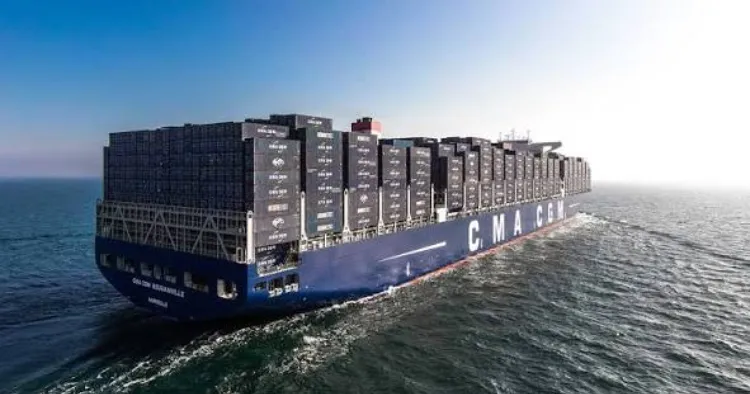
The State of the Maritime Transport Market in Late 2026 and the Rationale Behind the PSS
The period from November to January each year is generally regarded as the peak season for the container shipping industry. Demand for cargo transportation from Asia to Europe, the Mediterranean, and Africa rises sharply as retailers and manufacturers in major consumer markets accelerate imports for Christmas, New Year, and early-year promotional campaigns.
Against this backdrop, carriers frequently face vessel shortages, insufficient empty container supplies, congestion at certain major ports, and rising operating costs. The PSS is a financial instrument used by carriers to offset a portion of these increased costs, while simultaneously moderating booking demand during the peak period.
For CMA CGM – one of the carriers with the most extensive network and largest market share on the Asia–Mediterranean routes – the announcement of new PSS levels at this point in time reflects the reality that the market continues to experience considerable pressure on vessel and container supply in the fourth quarter of 2026.

What Is the Peak Season Surcharge (PSS)? Why Should Enterprises Pay Attention?
The PSS (Peak Season Surcharge) is a supplementary charge levied in addition to the basic ocean freight. It is not a permanent, fixed charge, but is applied only for a defined period, typically coinciding with a phase of elevated demand.
An important point that many enterprises tend to overlook is that the PSS is determined by the cargo loading date, rather than the booking date or the date of issuance of the bill of lading. This means that even if a booking was made early, if the vessel’s actual cargo loading date falls within the PSS application period, the new surcharge level must still be paid.
In addition, the PSS generally applies to virtually all equipment types (dry, reefer, out-of-gauge, and paying empty containers), meaning that there are few significant exceptions.
Details of the PSS Levels on the Asia – Mediterranean and North Africa Routes
According to CMA CGM’s official announcement, from 25 November 2026, the carrier will apply the following peak season surcharge levels to cargo originating from all major ports in Asia bound for base ports in the Mediterranean and North Africa regions:
- 20-foot container: USD 800 per container.
- 40-foot container: USD 1,600 per container.
This level applies uniformly to:
- Dry containers
- Reefer containers
- Out-of-gauge (OOG) containers
- Paying empty containers
This represents a relatively high PSS compared with many previous adjustments on the same route. For a 40-foot container, a surcharge of USD 1,600 can significantly increase total transportation costs, particularly for goods of comparatively low unit value or high volume, such as agricultural products, household goods, components, and garments and textiles.
The point of application is determined strictly according to the cargo loading date. Enterprises should therefore carefully verify vessel schedules and cut-off dates to avoid being subjected to a higher charge than anticipated.
PSS Adjustment on the Far East – Mauritius (Port Louis) Route
For the route from the Far East to the port of Port Louis (Mauritius), CMA CGM has also adjusted the PSS with an earlier effective date, from 15 November 2026.
Specifically:
- Cargo originating from China and the Special Administrative Regions (Hong Kong, Macau): USD 800 per TEU.
- Cargo originating from North East Asia and South East Asia, including Vietnam: USD 500 per TEU.
This surcharge applies to all types of cargo. A positive point for Vietnamese enterprises is that the USD 500 per TEU level is markedly lower than that applied to goods exported from China. This may confer a certain competitive advantage on Vietnamese goods when exporting to the Mauritian market and adjacent regions.
Related Surcharge Items and Legal Provisions to Note
CMA CGM affirms that the PSS is a distinct charge, levied in addition to the basic ocean freight. Beyond the PSS, depending on the specific shipment and route, customers may still be required to pay a number of other charges currently in effect, including:
- Bunker-related charges (Bunker Adjustment Factor – BAF, Emergency Bunker Surcharge – EBS, etc.)
- Terminal Handling Charges (THC)
- Security and safety surcharges
- Other surcharges in accordance with the regulations of the carrier or the ports of loading/discharge
For cargo originating from China, the application of the surcharge must comply with the filing requirements of the Shanghai Shipping Exchange (SSE). In certain cases, the PSS may be incorporated into the ocean freight rather than itemized separately on the invoice. Similarly, the PSS level on the Asia – Mediterranean and North Africa routes is also subject to the price management and filing regulations of the local jurisdiction at the destination.
Impact on Vietnamese Exporting Enterprises
For Vietnamese enterprises currently exporting to the Mediterranean, North Africa, and Mauritius, CMA CGM’s announcement has several clear implications:
- Mediterranean and North Africa routes: A level of USD 1,600 per 40-foot container represents a substantial cost item. Enterprises exporting garments and textiles, wood products, furniture, agricultural products, and seafood need to recalculate their cost structures and renegotiate with partners where freight rates have not yet been finalized under contract.
- Mauritius route: The USD 500 per TEU level applicable to Vietnamese goods is comparatively easier to absorb, but it still increases costs relative to periods when no PSS is in effect.
- Enterprises operating under service contracts should also review the surcharge provisions to determine whether an exemption from, or reduction of, the PSS is available.
Furthermore, the fact that the PSS is determined by the cargo loading date makes export shipment planning even more critical. An early booking accompanied by a vessel schedule delay may result in a shipment falling within the new PSS window.
Recommendations for Cargo Owners and Freight Forwarding Enterprises
To mitigate the impact of the new PSS levels, enterprises may consider the following measures:
- Review export shipping schedules: Prioritize loading cargo before 15 November (for the Mauritius route) and before 25 November (for the Mediterranean route), where still feasible.
- Calculate the full logistics cost: Consider not only the basic ocean freight but also the PSS, THC, BAF, and all other related surcharges.
- Negotiate with forwarders and carriers: For large cargo volumes or regular customers, preferential PSS levels or all-inclusive freight packages may be negotiated.
- Monitor subsequent announcements closely: PSS levels are frequently extended or adjusted in accordance with market conditions. Timely updates will enable enterprises to act more proactively.
Consider diversifying carriers: Compare PSS levels and total costs between CMA CGM and other carriers on the same route in order to select the optimal option.
Source:
https://phaata.com
Viet Star Shipping Agency Co., Ltd.
📞 +84 3930 01002
🏘️27-29 Ngo Thi Bi Street, Tan Hung Ward, Hochiminh City