Amid intensifying international competition, logistics costs and seaport connectivity have become decisive factors for the competitiveness of Vietnamese goods. Despite possessing strong advantages in production, export, and a coastline stretching across the country, uncoordinated infrastructure, fragmented planning, and limited regional connectivity still force many cargo flows to take detouring journeys, driving up costs and prolonging transit times. Restructuring port systems by clusters, developing multimodal transport, and establishing inter-regional coordination mechanisms are emerging as vital solutions to unblock cargo flows, expand economic development space, and boost export competitiveness.
Fragmented Port Infrastructure Forces Vietnamese Goods to Take Detours
Vietnam holds major geographic advantages with a long coastline and seaport systems distributed across multiple economic regions. However, port exploitation capacities and inter-regional logistics connectivity have yet to fully realize their potential. Many localities with high export volumes lack seaport gateways capable of receiving large-capacity vessels, forcing cargo to be transported to other seaport hubs prior to export.
The Mekong Delta (ĐBSCL) is a prime example. As a vital agricultural, aquatic, and export production hub for the entire country, its capacity to ship goods directly to international markets via regional seaports remains limited.
According to the World Bank (WB), the demand for import-export cargo transport in the Mekong Delta reaches at least 18 million tons annually, with trade values exceeding $31 billion. Yet, only about 10% of this cargo—equivalent to 1.8 million tons—is shipped directly through regional ports. Nearly 90% of the remaining cargo must be trucked to Ho Chi Minh City and the Southeastern region for export.
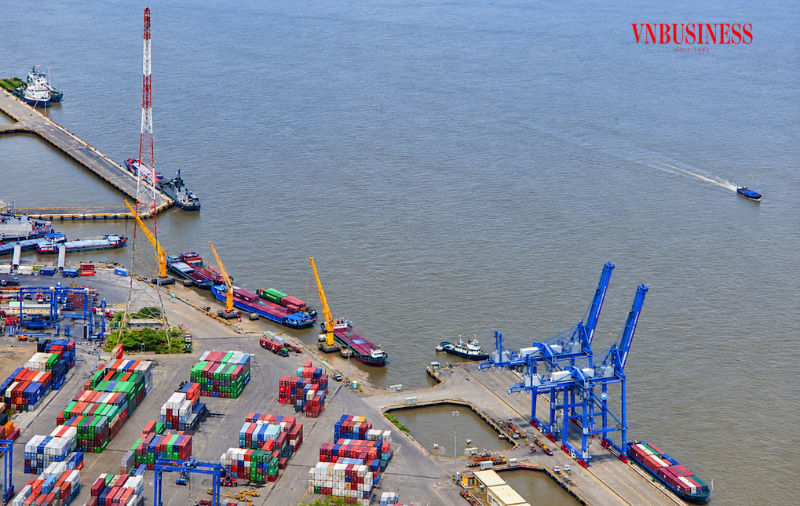
This reality highlights deficiencies in the organization of transport and logistics systems within a major production region. Goods must endure multiple handling and transshipment stages before reaching export ports, escalating transportation costs, warehousing expenses, and delivery times.
Meanwhile, Cái Cui and Trà Nóc ports in Cần Thơ lack the capacity to accommodate large vessels, severely constraining direct export shipments from the Mekong Delta. This not only impairs port infrastructure efficiency but also erodes the competitive edge of regional enterprises.
For goods with stringent delivery timelines and preservation demands—such as agricultural and aquatic products—undergoing multiple transit legs places heavy pressure on cold storage systems, specialized vehicles, and preservation costs.
Consequently, the core challenge goes beyond merely building more seaports; it requires reorganizing the entire transport network, linking ports directly with raw material zones, industrial parks, distribution centers, and inter-regional transport arteries.
This topic is expected to take center stage at the Mekong Connect 2026 Forum, scheduled for early December. The forum focuses on solutions for marine economic development, seaports, and river ports, aiming to boost logistics connectivity, cut transport costs, and elevate export capabilities across the Mekong Delta.
Beyond the Mekong Delta, limitations in seaport connectivity and logistics also plague other economic regions. In the Central – Central Highlands region, despite coastal seaports and East-West economic corridors, export goods still rely heavily on road transport.
Transverse transport axes, cargo collection points, cold storage facilities, and multimodal transport services remain uncoordinated. Consequently, exploiting seaport advantages falls short of matching the region’s production and trade potential.
These challenges were also highlighted at the Vietnam Logistics Forum 2026, hosted by the Ministry of Industry and Trade in early November in Gia Lai. Inefficiencies in transport connectivity and logistics chains demonstrate that developing infrastructure via isolated, localized projects is reaching its limits, underscoring the need for a more systemic, region-wide coordinated approach.
Planning Seaports by Clusters to Overcome Fragmented Investment
A primary reason behind subpar seaport exploitation efficiency lies in fragmented planning and uncoordinated infrastructure investment. In several regions, port projects have been implemented independently without coordination mechanisms among investors, resulting in adjacent berths that cannot operate cohesively.
The lack of synchronization among wharves, back-up yards, warehousing systems, handling equipment, and connecting transport infrastructure prevents capital investments from being fully optimized. Conversely, a coordinated cluster approach allows port areas to share equipment, infrastructure, and operating capacities, thereby cutting operational costs and maximizing capital efficiency.
In response, the Vietnam Ship Agents, Brokers and Maritime Services Association (Visaba) has proposed planning seaports along “contiguous plots, contiguous banks” principles to integrate and share infrastructure.
This solution aims to resolve decentralized, uncoordinated investments among adjacent berths while fostering large-scale port clusters with unified operating capacities.
Mr. Nhữ Đình Thiện, General Secretary of Visaba, noted that port planning must ensure continuous wharf alignments synchronized in elevation and technical standards. Furthermore, seamless connectivity must be established between wharves, back-up yards, logistics zones, and external transport networks.
According to Mr. Thiện, mechanisms must be finalized to enable shared infrastructure and equipment among adjacent berths when conditions permit. This requires clear demarcation between shared infrastructure and specialized assets, safeguarding investor rights while ensuring reasonable cost allocation principles.
Initially, Visaba has proposed piloting this model at key port clusters such as Lạch Huyện, Cái Mép – Thị Vải, and Liên Chiểu.
Rather than letting individual ports chart separate paths, organizing them into interconnected clusters enhances resource sharing, mutual support during operations, and cargo handling capacity.
Insights from international port clusters, including Singapore, demonstrate that coordinated planning helps reduce vessel wait times, boost cargo clearance productivity, and save logistics costs. When wharves and back-up areas are continuously linked, equipment can be rotated flexibly, curbing redundant investments.
For Vietnam, this approach is vital as import-export freight demand surges while pressure mounts regarding capital expenditure and infrastructure efficiency.
Developing seaports by clusters not only resolves technical bottlenecks but also lays the groundwork to restructure logistics chains professionally, modernly, and with robust international connectivity.
Establishing Inter-Regional Coordination Mechanisms and Unified Logistics Networks
Alongside seaport planning, regional linkage is recognized as a critical prerequisite for optimizing logistics operations. In reality, freight flows do not respect administrative boundaries, yet regional planning and infrastructure investments across many localities lack matching coordination.
When each locality prioritizes infrastructure based solely on local goals, it sparks investment overlaps, disjointed transport routes, and suppressed shared capacity utilization.
Addressing this, Ms. Đặng Minh Phương, Chairwoman of the Ho Chi Minh City Logistics and Port Association, emphasized that logistics cannot develop in isolation. In her view, administrative borders should never become boundaries for cargo flows. Regional linkage and seaport connectivity are no longer optional—they have become absolute necessities.
Ms. Phương pointed out that inland road and rail networks connecting to ports remain overlapping, uncoordinated, and prone to congestion. Meanwhile, Vietnam boasts a dense river network, yet investments in river ports and fairway channels fail to match its potential.
Consequently, freight transport relies excessively on road networks, heaping pressure on traffic infrastructure, fuel consumption, and transit times.
Overcoming this calls for establishing inter-regional coordination mechanisms to synchronize seaport, transport, and logistics planning across localities. Each region’s functions, strengths, and roles within the broader transport network must be clearly defined to prevent scattered investments while maximizing shared capacity and infrastructure.
Ms. Phương proposed upgrading expressways, specialized railways, inland waterways, and links connecting ports with industrial parks and urban centers. Simultaneously, policies should encourage shifting cargo from roads to waterways and railways to slash transport costs, ease congestion, and shrink environmental footprints.
This direction holds profound significance for major agricultural production regions like the Mekong Delta, where dense waterways can support massive freight volumes at competitive costs.
With synchronized investment, inland water transport can become a vital linchpin connecting raw material zones to seaports, curbing reliance on highways and eliminating detours through major transshipment hubs.
Additionally, developing cargo consolidation points, logistics centers, and cold storage networks across production-heavy regions will streamline cargo flows more efficiently.
Crucially, inter-regional coordination mechanisms must be implemented substantively—extending beyond shared planning directives to concrete cooperation in investment, operations, and data-sharing among localities.
Cần Giờ and Cái Mép – Thị Vải: New Drivers for the Marine Economy
Within its marine economic and logistics strategy, the Southern region stands before a golden opportunity to expand its footprint in international maritime shipping networks.
Under plans unveiled in early November 2026, Ho Chi Minh City targets transforming into a modern, green, smart, and internationally competitive marine economic hub by 2030.
A cornerstone of this blueprint involves building the Cần Giờ International Transshipment Port coupled with a Free Trade Zone (FTZ), tying together the Cần Giờ – Cái Mép – Thị Vải – Côn Đảo maritime growth pole.
This orientation opens doors for expanding seaport services, logistics, multimodal transport, international trade, and high-value maritime services.
The Cái Mỹp – Thị Vải – Cần Giờ port cluster is expected to integrate deeply into regional and international logistics networks, elevating Ho Chi Minh City’s role within global supply chains and maritime transport.
Nonetheless, seaport scale and capacity can only deliver maximum efficiency when linked seamlessly with production regions, industrial parks, and domestic logistics systems.
Particularly, leveraging the capabilities of the Cái Mép – Thị Vải deep-water port, cementing its international transshipment status, while strengthening links with satellite ports and production zones is essential.
This is critical to forging an integrated transport network where major ports act as primary gateways, while satellite ports, river ports, and logistics centers handle regional cargo collection and distribution.
If organized effectively, this model allows goods from production bases to access international shipping lanes directly, cutting down transshipment iterations and optimizing logistics costs.
For the Mekong Delta, strengthening integration with the Cái Mép – Thị Vải cluster and the upcoming Cần Giờ International Transshipment Port is paramount for widening export market access.
Nonetheless, the long-term solution remains developing a synchronized regional seaport system, boosting current port capacities, and linking effectively with international port webs.
Digital Transformation and Green Logistics Elevate Seaport Competitiveness
Alongside infrastructure investment and connectivity expansion, digital and green transformations are emerging as twin pillars in modernizing the logistics industry.
Amid soaring demands across international supply chains, seaport competitiveness depends no longer solely on wharf scale, vessel reception capacity, or throughput volume, but equally on service quality, processing speed, and operational management.
According to Ms. Đặng Minh Phương, building a shared data platform connecting businesses, seaports, customs authorities, and banks is essential to shorten customs clearance times, streamline transactions, and boost collaborative efficiency.
Applying digital technologies to port and logistics management helps enterprises track cargo journeys, manage fleets, optimize transit schedules, and minimize wait times at transshipment nodes.
Crucially, when data flows seamlessly among supply chain stakeholders, cargo coordination becomes transparent and proactive, clipping extra costs triggered by information gaps or handoff delays.
Parallel to digital transformation, advancing green logistics is growing acutely urgent.
Seaports must prioritize investments in clean technologies, renewable energy, energy-efficient equipment, and environmentally friendly operating workflows. This not only curbs environmental impacts but also elevates the brand image and global competitiveness of Vietnam’s seaport system.
In particular, green trends introduce fresh demands for transport and logistics enterprises. Optimizing transit modes, eliminating redundant mileage, and lifting the share of waterway and rail transport directly trim fuel consumption, emissions, and operating costs.
Thus, digital and green transformations must advance hand-in-hand with seaport infrastructure restructuring and inter-regional connectivity. This forms the bedrock for a modern logistics ecosystem capable of meeting rising global trade standards.
Restructuring Seaport Systems to Help Vietnamese Goods Reach Farther
Experience shows that Vietnam’s logistics hurdles cannot be resolved simply by building extra seaports or expanding capacity at a few major gateways. More importantly, the transport network must be reorganized toward integration, synchronization, and resource sharing across localities.
For heavy production regions like the Mekong Delta, seaport development must merge with highway, waterway, railway, and logistics center networks. Ports must be planned in clusters, backed by frameworks for shared infrastructure and equipment, with clear roles assigned to each node in the transport network.
For the Southern region, linking Cần Giờ and Cái Mép – Thị Vải must be embedded within Ho Chi Minh City’s broader marine economic and international logistics strategy, alongside robust integration with regional production bases.
Simultaneously, inter-regional coordination mechanisms must be finalized promptly to drive data sharing, cultivate multimodal transport, and encourage green logistics models.
When seaports connect smoothly with production bases, industrial parks, and distribution networks, goods bypass unnecessary transport legs, shorten delivery windows, and maximize infrastructure efficiency.
Notably, driving down logistics costs directly sharpens export competitiveness, empowering Vietnamese goods to penetrate international markets smoothly.
The logistics race is intensifying fiercely, with advantages favoring not merely nations possessing massive seaports, but economies capable of organizing seamless transport chains, efficient connectivity, and cost optimization.
Therefore, restructuring seaport systems into clusters, cultivating multimodal integration, and setting up inter-regional coordination mechanisms are no longer long-term options—they are pressing mandates.
Only by operating as a unified network can seaports truly serve as engines of regional economic growth, helping Vietnamese goods break free from detours, shedding logistics costs, and lifting their standing in global trade.
Source:
https://vnbusiness.vn
https://soha.vn
Viet Star Shipping Agency Co., Ltd.
📞 +84 3930 01002
🏘️27-29 Ngo Thi Bi Street, Tan Hung Ward, Hochiminh City