The country’s coconut cultivation area has expanded to nearly 201,000 hectares, while export value has surpassed $1.1 billion.
The figures reflect the expansion of Vietnam’s coconut production, processing and branding sectors. The industry now has a broad supply chain covering food, pharmaceuticals, cosmetics, timber, handicrafts, as well as semi-processed products and raw materials for various industries.
Vietnam’s Coconut Industry Continues to Expand
In 2010, Vietnam had around 140,000 hectares of coconut plantations and generated only $180 million in export revenue. Fifteen years later, the cultivation area had increased to nearly 201,000 hectares, while export value had risen to more than $1.1 billion.
Vietnam currently ranks sixth in Asia and seventh globally in terms of coconut cultivation area, while ranking fifth in Asia for brands of processed coconut products.
Overall, Vietnam’s coconut industry ranks fourth in Asia and fifth globally, highlighting the sector’s growing strength in both production and processing.
Cao Ba Dang Khoa, Secretary-General of the Vietnam Coconut Association (VCA), said the country’s coconut industry now includes around 600 businesses and establishments involved in coconut production and trade. Their activities span a wide range of sectors, from food and pharmaceuticals to cosmetics, timber, handicrafts and industrial raw materials.
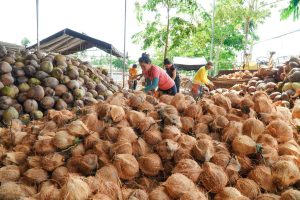
Coconut Export Factories Increase Nearly Tenfold
The growth of the industry is also reflected in the number of coconut export-processing facilities. In 2015, Vietnam had only eight export factories nationwide. By 2025, that number had increased to 75.
Many of these facilities have adopted advanced technologies, developed tens of thousands of hectares of standardized raw-material growing areas and built strong brands for international markets.
Meanwhile, many coconut-buying businesses and cooperatives now generate annual revenues of more than VND100 billion. They have invested in improving procurement and production facilities, while some have also developed organic raw-material supply areas to provide inputs for processing plants.
These developments have strengthened the links between farmers, processors and export markets, allowing farmers to become more closely integrated into the wider coconut value chain.
Cooperatives Evolve into Business Partners for Farmers
Nguyen Van Hay, a representative of a cooperative in An Hoi Commune, Vinh Long Province, said the cooperative has moved beyond simply collecting coconuts to become a business partner for farmers.
The cooperative signs long-term purchasing contracts, helping farmers secure stable markets and reduce the impact of price volatility.
Hay said that in 2025, the cooperative guaranteed the purchase of more than 5 million coconuts, generating revenue of approximately VND100 billion from both fresh coconuts and processed coconut products.
The stronger connection between farmers, cooperatives and processing companies has therefore become an important factor in upgrading Vietnam’s coconut industry.
Vinh Long Emerges as a Key Coconut-Producing Region
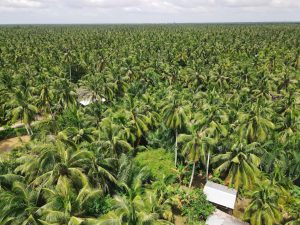
Vinh Long Province is one of the country’s key coconut-producing areas, with more than 120,000 hectares of coconut plantations, according to the report. The area accounts for more than 50% of Vietnam’s total coconut-growing area.
The province is expected to produce approximately 1.3 million tonnes of coconuts in 2025, with export revenue estimated at around $500 million.
Source :
www.tienphong.vn
Viet Star Shipping Agency Co., Ltd.
📞 +84 3930 01002
🏘️27-29 Ngo Thi Bi Street, Tan Hung Ward, Hochiminh City