The number of ultra-large container ships transiting the Suez Canal surged to 166 in the third quarter of 2026, despite ongoing security risks in the Red Sea. According to maritime consultancy Drewry, shipping lines are resuming Suez Canal transits not only to reduce costs but also to optimize network capacity, vessel utilization, and service reliability.
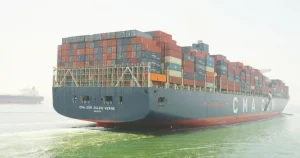
Suez Canal Container Traffic Shows Signs of Recovery
Container traffic through the Suez Canal is gradually recovering, even as security risks in the Red Sea remain unresolved. Data from the Suez Canal Authority (SCA) shows that an increasing number of shipping lines are returning to the route after previously diverting vessels to avoid the high-risk area.
In the third quarter of 2026, 166 large and ultra-large container ships transited the canal, compared with just 16 during the same period in 2025. According to the SCA, the category includes vessels with a net tonnage exceeding 130,000 NT, as well as ultra-large container ships.
The combined net tonnage of these vessels reached 29 million NT in Q3 2026, up significantly from 2.4 million NT recorded in the same quarter a year earlier.
Admiral Ossama Rabiee, Chairman of the SCA, emphasized the canal’s strategic importance to container shipping, citing its potential to reduce operating costs and enable shipping lines to benefit from economies of scale.
Rabiee also highlighted mounting cost pressures on shipping companies, including rising fuel prices and the freight costs borne by cargo owners. By shortening sailing distances and transit times, the Suez Canal can help improve vessel operating efficiency.
Shipping Lines Gradually Resume Suez Canal Routes
The SCA continues to encourage shipping lines to return to the canal and expects traffic volumes to maintain their recovery momentum.
CMA CGM is among the carriers that have resumed using the route. Maersk, Hapag-Lloyd, MSC, and OOCL are also gradually restoring operations on services passing through the Suez Canal and the Red Sea. COSCO has reinstated schedules for some vessels, while the Premier Alliance, comprising ONE, HMM, and Yang Ming, is reportedly preparing to resume operations in the region.
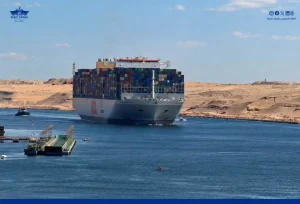
On October 13, the SCA recorded two large container ships operated by CMA CGM transiting the canal.
One of them was the CMA CGM Pantheon, which has a capacity of 24,212 TEU and a deadweight tonnage of 233,559 DWT. Entering service in July, the French-flagged vessel transited the canal in a northbound convoy while sailing from Tangier Med, Morocco, to Port Klang, Malaysia.
The second vessel, the CMA CGM Monte Cristo, transited the canal in a southbound convoy on the same day. Flying the Maltese flag, the ship has a capacity of 16,204 TEU and a deadweight tonnage of 158,064 DWT. It was also heading towards Port Klang.
These transits highlight the gradual return of large container vessels to the Suez Canal, although the pace of recovery will continue to depend on security conditions and individual carriers’ operational decisions.
Drewry: The Decision to Return to Suez Goes Beyond Cost Savings
In a report published in early October, Drewry examined why shipping lines are returning to the Suez Canal despite continuing security concerns.
According to the consultancy, the threats that previously prompted carriers to divert vessels around the Cape of Good Hope have not completely disappeared. Recent attacks by Houthi forces and fighting near the Bab el-Mandeb Strait continue to create uncertainty for maritime operations in the region.
Drewry noted that the direct financial benefits of transiting the Suez Canal may be relatively limited when assessed solely on a voyage-cost basis.
Its estimates suggest potential savings of approximately US$43 per slot, equivalent to around US$1 million for a round-trip voyage. These figures exclude war-risk insurance premiums.
Drewry stated that the growing willingness of container shipping lines to return to the Suez Canal cannot be adequately explained by comparing the direct costs of sailing through Suez with those of taking the longer route around the Cape of Good Hope.
Beyond potential round-trip cost savings, carriers must also consider shorter transit times, the ability to operate more voyages, the stability of their global schedules, and competitive pressures.
The consultancy concluded that the decision to return to Suez is not simply a choice between two routes based on the economics of an individual voyage. Instead, it involves broader considerations related to network design, vessel capacity, and customer service, with transit times, vessel utilization, and schedule reliability all playing important roles.
Network Efficiency Becomes a Key Factor in Route Selection
The gradual return of large container ships to the Suez Canal reflects a broader shift in how shipping lines evaluate their routing strategies.
For carriers operating extensive global networks, shorter sailing distances can free up vessel capacity and potentially enable additional voyages within a given period. This can improve fleet utilization and help maintain service frequency across major trade lanes.
A more direct route can also support schedule planning and improve coordination between ports, terminals, and inland transportation providers. However, these benefits must be weighed against potential security threats, insurance costs, and the possibility of further disruptions.
Consequently, shipping lines are likely to continue assessing the Suez Canal on a case-by-case basis, taking into account the operational requirements of individual services and the prevailing security situation.
Red Sea Security Remains a Critical Consideration
Although Suez Canal traffic has increased significantly compared with the third quarter of 2025, the recovery does not necessarily indicate that maritime security risks have subsided.